

IGBT Static Stabilizer: Working Principle and Industrial Advantages
- Published 05 Aug, 2026
- 8 min read
An IGBT static stabilizer uses controlled power-electronic switching to correct voltage rapidly. Understanding the complete topology, rating and protection is more useful than comparing response-time claims alone.
What is an IGBT static stabilizer?
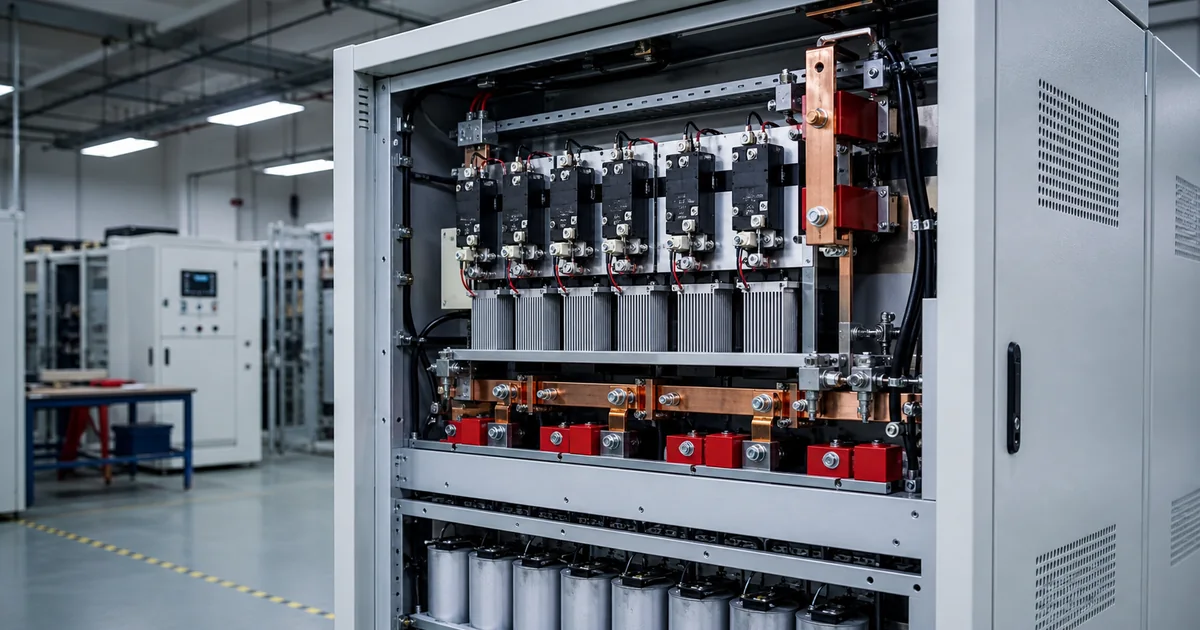
IGBT stands for insulated-gate bipolar transistor, a semiconductor switch used in many power-electronic converters. In a static stabilizer, IGBTs are controlled to regulate corrective voltage without a motorized variac. Sensors, a digital controller, switching modules, magnetics, filters, cooling and protection work as one system.
Different products may use different conversion and injection arrangements, so buyers should not assume every IGBT stabilizer behaves identically. Review the manufacturer single-line concept, input range, output regulation, overload and fault response for the proposed unit.
IGBT role in fast voltage correction
An IGBT can switch under electronic control far faster than a mechanical servo motor can reposition a brush. The controller measures voltage, calculates the correction and commands the switching stage. This allows rapid response to changes that could otherwise pass through to sensitive equipment.
Published response time and correction time are different measures and should be interpreted carefully. Sensor filtering, control calculation, switching, transformer behavior and the size of the voltage event all affect total output recovery.
Working principle explained simply
When input voltage falls, the stabilizer generates and injects a compensating voltage in the required direction. When input rises, it injects correction in the opposite direction. The series transformer combines this corrective component with the incoming supply so the load sees regulated output.
The controller also monitors current, temperature, phase and fault conditions. If the load exceeds limits or the input is outside the correction range, it may alarm, trip or transfer according to the bypass design. This protective behavior is as important as normal regulation.
Advantages over conventional stabilizers
Potential advantages include fast correction, high output accuracy, no carbon-brush correction mechanism and reduced mechanical wear. Static designs can be valuable where short voltage events cause controller resets or drive trips before a servo mechanism can respond.
These benefits do not remove every trade-off. Power modules and cooling must be correctly rated, electronic faults require trained service and initial cost may be higher. A conventional servo stabilizer may remain appropriate for slower sustained variation and less sensitive loads.
Applications in CNC, medical and industrial equipment
CNC controllers, servo drives, metrology systems, diagnostic electronics, laboratory instruments, robotic cells and high-speed production equipment can be sensitive to brief voltage movement. Static stabilization helps maintain input within a controlled band when the site supply is the cause.
Medical and lift-related installations have additional safety and regulatory requirements. The stabilizer must be coordinated with isolation, UPS, earthing and manufacturer instructions. It should never be presented as a substitute for required safety systems.
Selection checklist for buyers
Specify capacity, phase, voltage range, output accuracy, response and correction time, load crest factor, overload, efficiency, cooling, bypass and communications. Ask how the unit behaves during phase failure, extreme input and internal faults. Confirm local service access and availability of power modules.
Measure the site before choosing the technology. Adroit can assess sensitive industrial loads and recommend an appropriate configuration based on actual operating conditions rather than one performance headline.
For a fair comparison, give each supplier the same load schedule and measured voltage data. Clarify whether stated response time means sensing, control action or settled output, and under what voltage change it was tested. Confirm continuous current, semiconductor thermal design, phase imbalance behavior and operation during overload or upstream faults. Maintenance teams should understand bypass operation and have room to isolate the equipment. For critical processes, define commissioning tests for output accuracy and transient response so the claimed IGBT performance is measurable at the actual machine. Also verify spare-module availability, diagnostic logs and the safe procedure for transferring the protected load to bypass during planned service. Keep test results and settings with the electrical records for future fault diagnosis. Revalidate performance after major load or distribution changes, and record any approved setting adjustments made during service.
- Input range at full load
- Response and correction definitions
- Independent phase correction need
- Overload and fault behavior
- Cooling and ambient temperature
- Bypass and service strategy
FAQs
What is IGBT static stabilizer?
It is a voltage stabilizer that uses controlled IGBT power electronics rather than a motorized variac to apply rapid voltage correction.
How fast is static stabilizer correction?
It is generally much faster than servo correction, but exact response and recovery depend on design, event size and the manufacturer specification.
Is IGBT stabilizer suitable for CNC machines?
It can suit CNC controllers and drives that are sensitive to fast voltage changes when correctly rated for the machine and input range.
What are the benefits of static stabilizer?
Benefits can include fast correction, accurate output and fewer moving correction parts, subject to correct design and maintenance.
Which industries need IGBT static stabilizer?
CNC, automation, medical, printing, electronics, laboratories and precision manufacturing commonly evaluate static stabilization.
Related Products and Solutions
Related Articles
Need help choosing the right solution?
Contact Adroit Power Systems for stabilizers, UPS systems, power quality correction, solar UPS and industrial backup power guidance.