

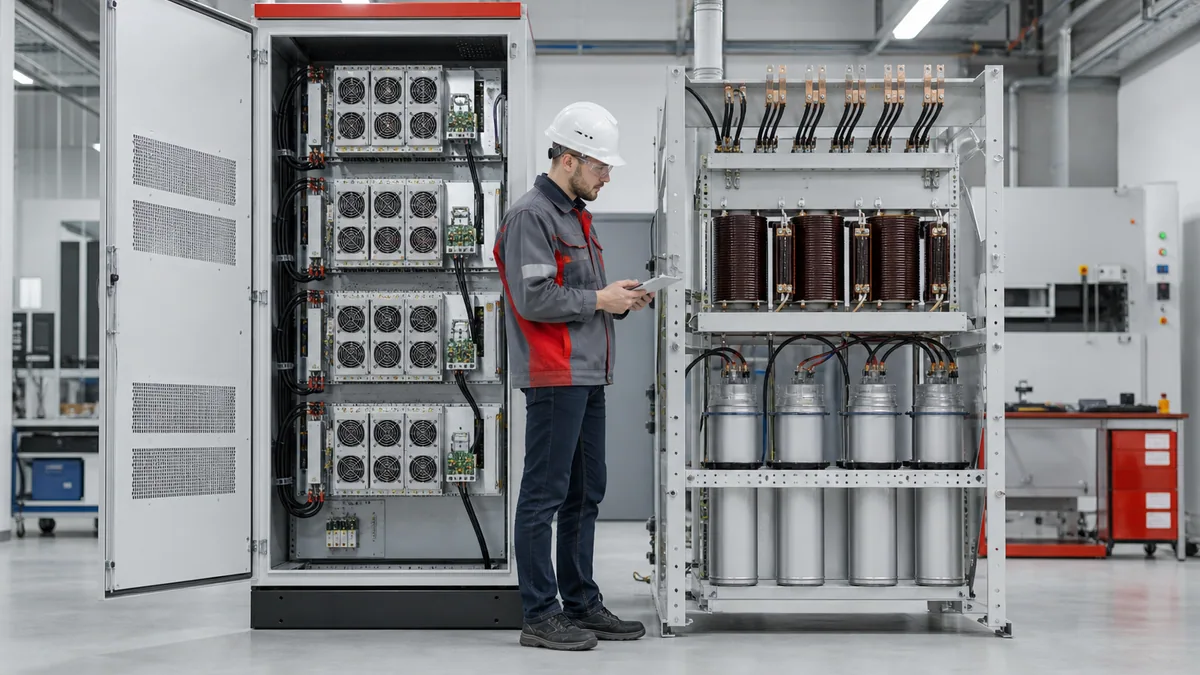
Active Harmonic Filter vs Passive Harmonic Filter
- Published 15 Jun, 2026
- 6 min read
Active filters dynamically inject compensating current, while passive filters are tuned circuits. Variable industrial loads often benefit from active harmonic filtering.
Passive harmonic filters
Passive filters are tuned for specific harmonic orders and can be cost-effective when the load profile is stable. However, they require careful design to avoid resonance and may not adapt well to changing loads.
Active harmonic filters
Active harmonic filters monitor load current and dynamically compensate harmonic distortion. They are useful where VFDs, UPS systems and power electronic loads vary during production.
Selection factors
- Measured harmonic distortion
- Load variation
- Existing capacitor banks
- Transformer loading
- Expansion plans
- Required power quality target
FAQs
Which filter is better for variable loads?
Active harmonic filters are generally better suited for changing load profiles.
Should harmonic filtering be selected without measurement?
No. A power quality audit should be performed before final selection.
Can an active harmonic filter compensate several harmonic orders?
Yes. A correctly sized active filter can dynamically inject compensating current across its designed spectrum as the nonlinear load changes.
Can a passive harmonic filter cause resonance?
A poorly coordinated passive filter can interact with capacitors and system impedance. A harmonic study is needed before selecting tuning and ratings.
Can active and passive harmonic filters be used together?
Yes. A hybrid design can use passive filtering for large predictable components and active filtering for changing residual distortion.
Related Products and Solutions
Related Location Solutions
Related Articles
Need help choosing the right solution?
Contact Adroit Power Systems for stabilizers, UPS systems, power quality correction, solar UPS and industrial backup power guidance.