

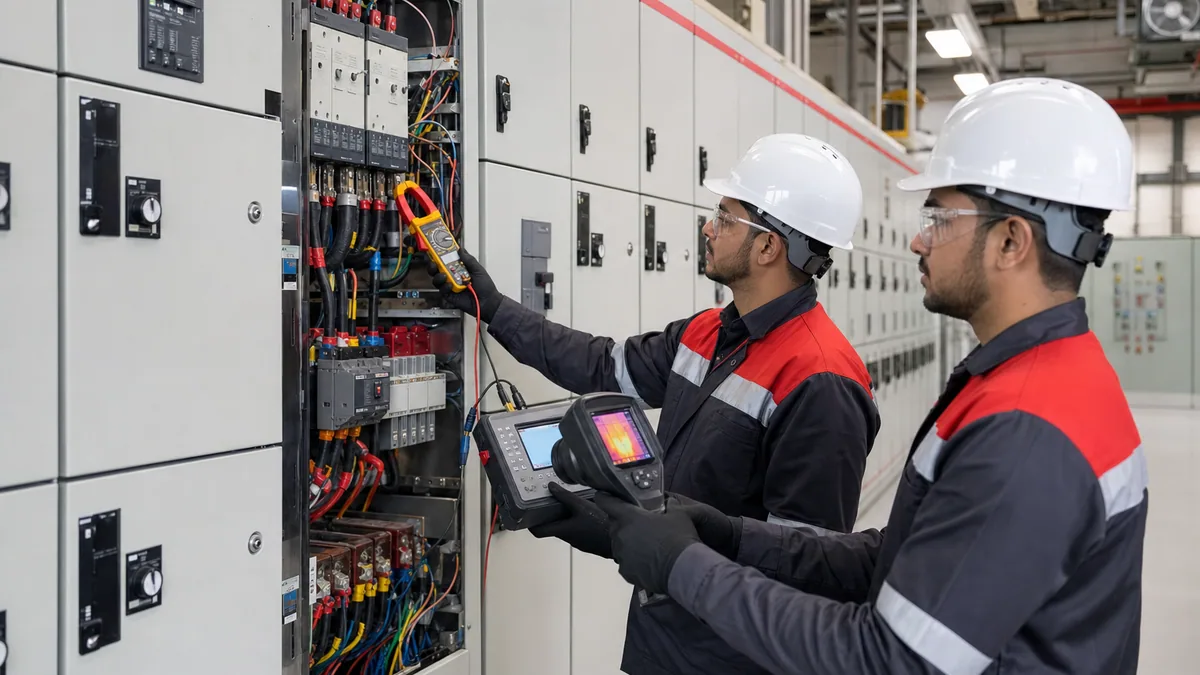
Power Quality Audit Checklist for Factories
- Published 18 Jun, 2026
- 7 min read
A power quality audit identifies whether production problems are caused by voltage fluctuation, harmonics, poor power factor, imbalance, wiring issues or load behavior.
Before measurement
- List critical machines and symptoms
- Collect electricity bills and penalty details
- Note production shift timings
- Identify recent equipment failures
- Mark transformer and panel ratings
Measurements to capture
- Voltage and current trend
- Phase imbalance
- Power factor and kvar demand
- THD voltage and THD current
- Load peaks and dips
- Neutral current and temperature observations
After the audit
The audit findings should lead to a practical recommendation: stabilizer, APFC, SVG, harmonic filter, UPS, transformer correction, cable improvement or a combination.
FAQs
When should a factory do a power quality audit?
When there are repeated trips, equipment failures, penalties, overheating, quality variation or unexplained downtime.
Can one device solve all power quality problems?
Usually no. Voltage, harmonics, power factor and backup require different solutions.
How long should a factory power quality audit monitor the supply?
Monitoring should capture normal shifts, starts and peak production; this may range from 24 hours to a week or more depending on load variability.
Where should power quality measurements be taken?
Typical points include the utility connection, transformer secondary, main panels and the terminals feeding equipment that experiences faults or trips.
What should a power quality audit report contain?
It should present voltage and current trends, events, THD, power factor, imbalance, root-cause findings and prioritized corrective recommendations.
Related Products and Solutions
Related Location Solutions
Related Articles
Need help choosing the right solution?
Contact Adroit Power Systems for stabilizers, UPS systems, power quality correction, solar UPS and industrial backup power guidance.