

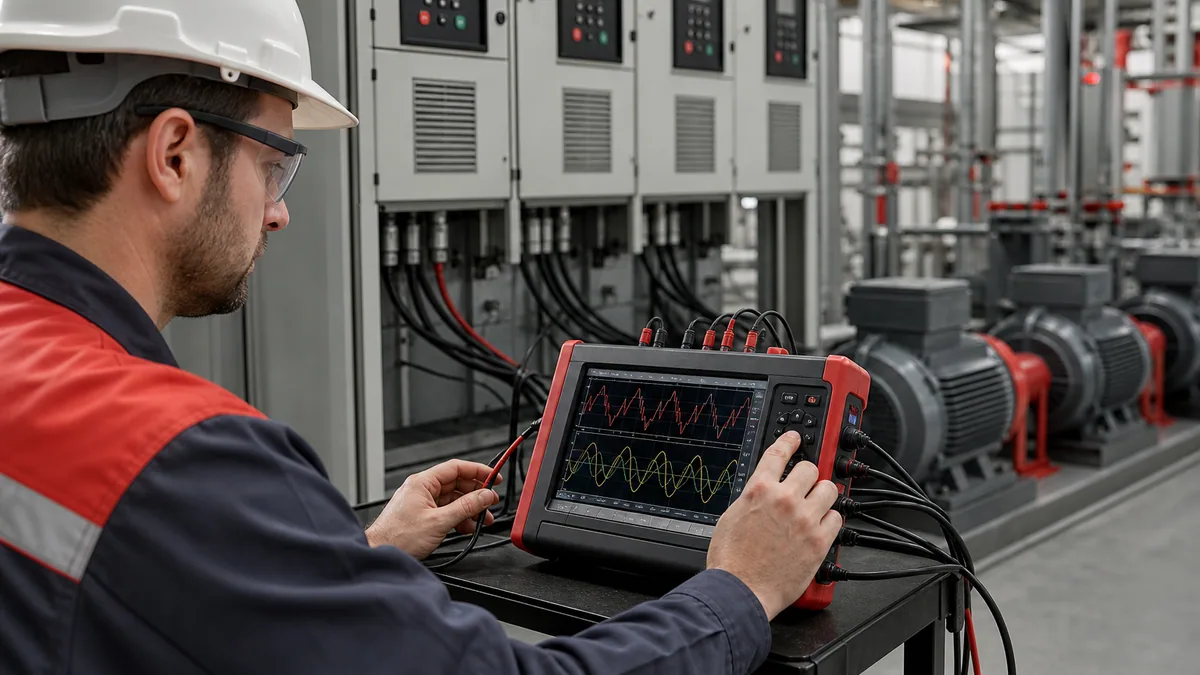
What Are Harmonics in Electrical Systems?
- Published 14 Jun, 2026
- 6 min read
Harmonics are unwanted frequency components in electrical systems, commonly caused by non-linear loads such as drives, rectifiers, UPS systems and power electronics.
Why harmonics occur
Non-linear loads draw current in pulses instead of smooth sine waves. This distorts current and sometimes voltage waveforms, creating harmonic components that can affect transformers, cables, capacitors and sensitive equipment.
Common symptoms
- Transformer overheating
- Capacitor bank failure
- Neutral overheating
- Breaker nuisance tripping
- Drive or control malfunction
- Poor power quality readings
How to control harmonics
A power quality study should measure total harmonic distortion and identify the source. Active harmonic filters or passive filters may be selected depending on load profile, harmonic order, current level and system design.
FAQs
Are harmonics the same as voltage fluctuation?
No. Harmonics are waveform distortion, while voltage fluctuation is a change in voltage magnitude.
Can harmonics damage capacitors?
Yes. Harmonic resonance and overload can damage capacitor banks if the system is not designed correctly.
What level of harmonic distortion is acceptable?
Acceptable THD depends on voltage level, equipment sensitivity, system strength and the limits applicable at the point of common coupling. Measurement is essential.
Which industrial equipment commonly creates harmonics?
Variable-frequency drives, UPS rectifiers, switched-mode power supplies, welders and other nonlinear electronic loads are common harmonic sources.
Can harmonics overheat transformers and neutral conductors?
Yes. Harmonic current can increase RMS current, transformer losses and neutral loading, leading to heat, reduced capacity and nuisance trips.
Related Products and Solutions
Related Location Solutions
Related Articles
Need help choosing the right solution?
Contact Adroit Power Systems for stabilizers, UPS systems, power quality correction, solar UPS and industrial backup power guidance.