

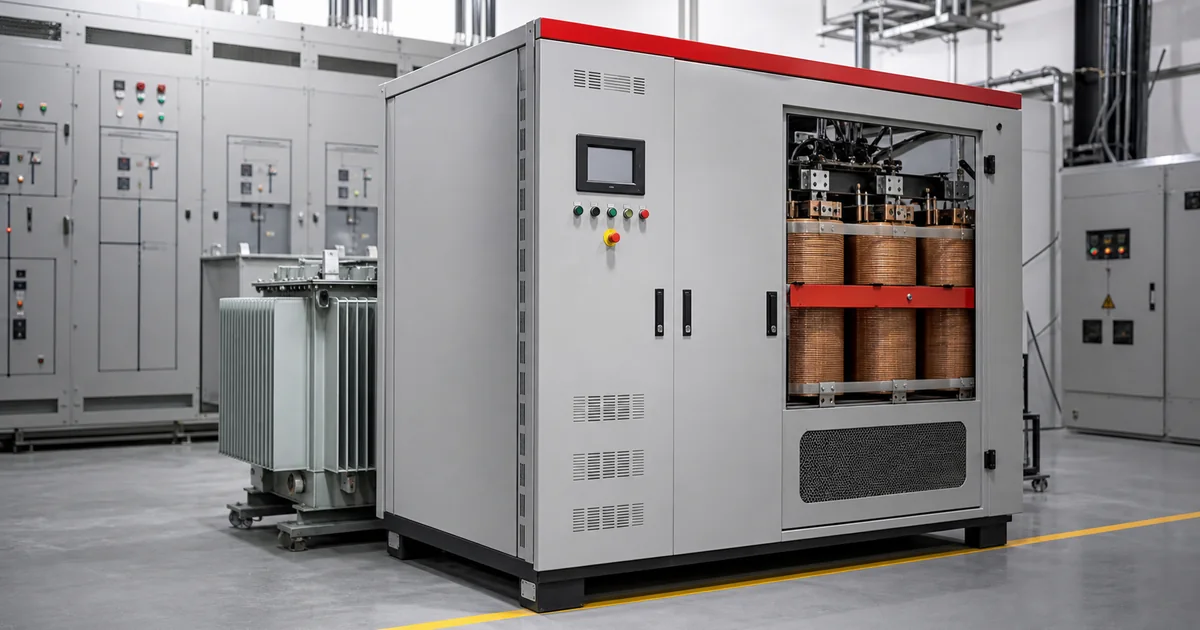
Servo Stabilizer Price Guide: What Affects 5kVA to 100kVA Cost?
- Published 11 Aug, 2026
- 8 min read
Servo stabilizer cost cannot be judged from kVA alone. Phase type, input range, cooling method, duty, protections, enclosure, installation and site conditions all influence the final configuration and quotation.
What affects servo stabilizer price?
A servo stabilizer is selected as an electrical system, not as a generic cabinet. Two units with the same nameplate capacity may differ substantially in input voltage range, output accuracy, transformer design, correction speed, protection, metering and enclosure construction. Those differences affect materials, engineering effort and price. A realistic comparison therefore needs a common technical specification rather than only a kVA number.
Load type also matters. A resistive commercial load behaves differently from motors, CNC drives, textile machines or medical equipment. Starting current, continuous duty, phase imbalance and the sensitivity of connected controls influence component sizing. Buyers should share recent voltage measurements, load details and operating hours so suppliers can quote equipment that is suitable rather than merely inexpensive.
Capacity range: 5kVA to 100kVA
Small 5 kVA or 10 kVA stabilizers may protect selected home, office, laboratory or shop loads, while larger ratings can support machinery groups or building services. As capacity increases, conductor size, transformer material, switching hardware, cabinet strength, ventilation and protection ratings normally increase as well. Price does not rise in a perfectly straight line because standard product ratings and construction methods vary.
A 100 kVA requirement should not be assumed simply because the upstream transformer is 100 kVA. The stabilizer should be based on the load being protected, its power factor, diversity, starting demand and expected expansion. The guide on choosing the correct rating provides a practical next step before requesting a commercial quotation.
Single phase vs three phase price factors
Single-phase stabilizers are usually considered for smaller residential and commercial loads supplied from one phase. Three-phase designs serve three-phase machinery and larger installations, requiring additional sensing, control and power components. The choice must follow the actual supply and load arrangement; selecting a phase type only because it appears cheaper can create an unusable or unsafe installation.
Three-phase systems also require a decision between balanced and independent phase correction according to the network and load. Cable termination, bypass arrangement, breaker coordination and phase monitoring can affect the delivered scope. Compare quotations only after confirming whether these items are included.
Air cooled vs oil cooled stabilizer cost
Air-cooled models use natural or forced air to remove heat and are often practical for lower and medium ratings in clean, ventilated rooms. Oil-cooled stabilizers use insulating oil and a tank arrangement for thermal performance in higher-capacity or demanding continuous-duty applications. Oil cooling can add tank, oil, testing and handling requirements, but cooling type should be chosen for duty and environment rather than price alone.
Installation space, ambient temperature, dust, ventilation and maintenance access should be reviewed. An air-cooled unit in a hot, poorly ventilated room may not be the economical choice over its working life. Likewise, an oil-cooled unit may be unnecessary for a modest indoor load with suitable ventilation.
Protection features that affect price
Common options include input and output breakers, under-voltage and over-voltage protection, phase failure and phase sequence protection, overload protection, surge protection, manual or automatic bypass, meters, alarms and communication. The correct package depends on the protected equipment and how the site electrical system is coordinated. More features are not automatically better if they duplicate upstream protection or are specified without proper settings.
Ask whether the quotation covers cabling, termination, bypass, commissioning, transport and taxes. A low equipment-only figure can become less attractive when essential installation items are added later. Warranty terms and access to service should also be compared on the same basis.
Why site assessment matters before final pricing
A site assessment can confirm minimum and maximum input voltage, phase imbalance, load current, starting behavior, ambient conditions and the location available for installation. These observations determine correction range and thermal duty, both of which affect stabilizer design. Where voltage varies by shift or season, short measurements may be insufficient; logged data gives a better design basis.
Adroit can review application and site information before recommending a configuration. The resulting quotation should identify capacity, phase, input range, output tolerance, cooling, protection and included services. This makes technical and commercial comparison clearer while avoiding unsupported price promises.
FAQs
What is the price of a servo stabilizer?
There is no responsible universal price. Capacity, phase, input range, cooling, protection, enclosure and installation scope must be defined before an accurate quotation can be prepared.
Why does servo stabilizer price vary by kVA?
Higher capacity generally needs more transformer material, larger conductors, switching hardware, cooling and a stronger enclosure, although standard ratings and design details also affect cost.
Is an oil cooled servo stabilizer costlier than an air cooled model?
Oil-cooled construction may cost more because of its tank, oil and thermal design, but the correct choice depends on capacity, duty and environment rather than initial price alone.
How do I choose the correct kVA?
Calculate the protected running load, confirm power factor and phase, review starting current and future expansion, then validate the result against the input voltage range.
Does installation affect final cost?
Yes. Cable size and distance, breakers, bypass, civil base, ventilation, transport, commissioning and site access can change the delivered project cost.
Related Products and Solutions
Related Articles
Need help choosing the right solution?
Contact Adroit Power Systems for stabilizers, UPS systems, power quality correction, solar UPS and industrial backup power guidance.