

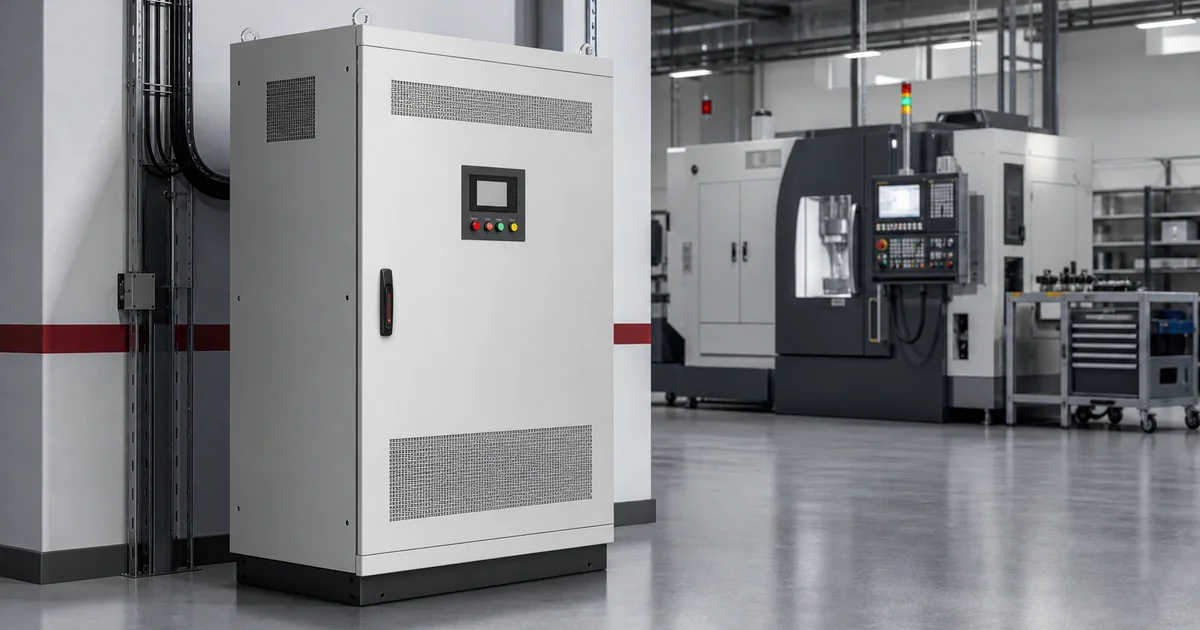
What Is a Static Stabilizer? Working, Benefits and Applications
- Published 06 Aug, 2026
- 8 min read
A static stabilizer corrects voltage electronically without a motor-driven variac. Its fast response makes it suitable for sensitive controls, CNC machinery, medical systems and automation that cannot tolerate prolonged voltage variation.
What is a static stabilizer?
A static voltage stabilizer is a power-conditioning system that senses incoming voltage and applies electronic correction to maintain a controlled output. Unlike a conventional servo stabilizer, it does not use a servo motor moving a carbon brush across a variac. The absence of that mechanical correction path allows a much faster response.
Static stabilizers are used where equipment can trip or malfunction during rapid voltage changes. They are available in ratings and input ranges selected for the site. The word static describes the correction method; it does not mean the equipment is maintenance-free or suitable for every power problem.
How does a static stabilizer work?
The controller continuously measures input and output voltage. Power electronic switches regulate the voltage injected through a transformer so the output remains near its set point. The control system adjusts switching rapidly as the incoming supply changes, subject to the unit input range, rating and protection limits.
The exact topology varies by manufacturer and capacity. Buyers should review input range, output accuracy, response and correction time, efficiency, overload capability, cooling, bypass and protection. One headline response figure should not replace the complete specification.
Static stabilizer vs servo stabilizer
Servo stabilizers use electromechanical movement and are established across a wide range of industrial capacities. Static stabilizers use electronic switching and generally provide faster correction with fewer moving correction parts. Servo models may be economical for sustained voltage variation, while static designs are attractive for loads sensitive to short and fast changes.
The correct choice depends on voltage behavior, load type, capacity, environment, expected maintenance and budget. A comparison should use measured events rather than assuming that the faster technology is always necessary.
Where static stabilizers are used
Common applications include CNC and VMC machines, robotics, printing and packaging lines, medical electronics, laboratories, data processing, precision inspection and automated production. These loads combine drives, controllers and power supplies that can react to dips, imbalance and sudden voltage movement.
A static stabilizer does not provide battery backup. If a process must continue through an outage, an appropriately designed UPS may also be required. Harmonics and poor power factor should be measured separately because they need different corrective equipment.
Benefits for sensitive equipment
Fast correction can reduce voltage-related controller resets, drive alarms and contactor dropout. Electronic correction also avoids routine carbon-brush wear associated with a variac. Output accuracy and phase correction can help maintain a consistent electrical environment for precision equipment.
Benefits depend on correct sizing and installation. An overloaded static stabilizer, inadequate ventilation or input outside the specified range will not deliver the expected performance. Protection settings and bypass should be coordinated with the connected machine.
How to choose the right static stabilizer
Document load kVA, phase, power factor, minimum and maximum voltage, rate of voltage change, phase imbalance and the equipment tolerance. Review motor starting and regenerative drives where present. Select a correction range that covers measured conditions without relying on excessive oversizing.
Check response, correction time, overload, short-circuit coordination, cooling, bypass, metering and service access. Adroit can review application details and site measurements before recommending a static stabilizer configuration.
Ask suppliers to state output accuracy at the specified load and input range instead of quoting response claims without test conditions. Review phase imbalance behavior and the action taken when input moves outside the design range. Plan cable sizing, breakers, earthing, ventilation and maintenance isolation. For sensitive machinery, compare the stabilizer specification with the equipment maker voltage tolerance. A site study may also reveal harmonics or interruptions that voltage regulation cannot solve, allowing the buyer to select complementary power-quality equipment where necessary. Commissioning records should include phase readings before and after regulation, representative load current and tested alarm conditions so future maintenance has a reliable reference.
- Confirm actual load and phase current
- Measure voltage events at the equipment
- Specify output tolerance and correction need
- Coordinate bypass and protection
- Provide ventilation and maintenance clearance
FAQs
What is a static stabilizer?
It is an electronic voltage-correction system that regulates output without the motor-driven variac used in a conventional servo stabilizer.
How is static stabilizer different from servo stabilizer?
Static stabilizers use power electronics for faster correction, while servo stabilizers use a servo motor, variac and buck-boost transformer.
Is static stabilizer good for CNC machines?
It can be suitable because CNC controllers and drives may need fast voltage correction, but rating and input range must match the machine and site.
Where is fast voltage correction needed?
It is useful for automation, CNC, medical electronics, printing, robotics and other loads that react quickly to voltage events.
Does static stabilizer need maintenance?
Yes. It needs planned inspection of fans, filters, capacitors, power modules, connections, bypass, protection and cooling even though it has fewer moving correction parts.
Related Products and Solutions
Related Articles
Need help choosing the right solution?
Contact Adroit Power Systems for stabilizers, UPS systems, power quality correction, solar UPS and industrial backup power guidance.