

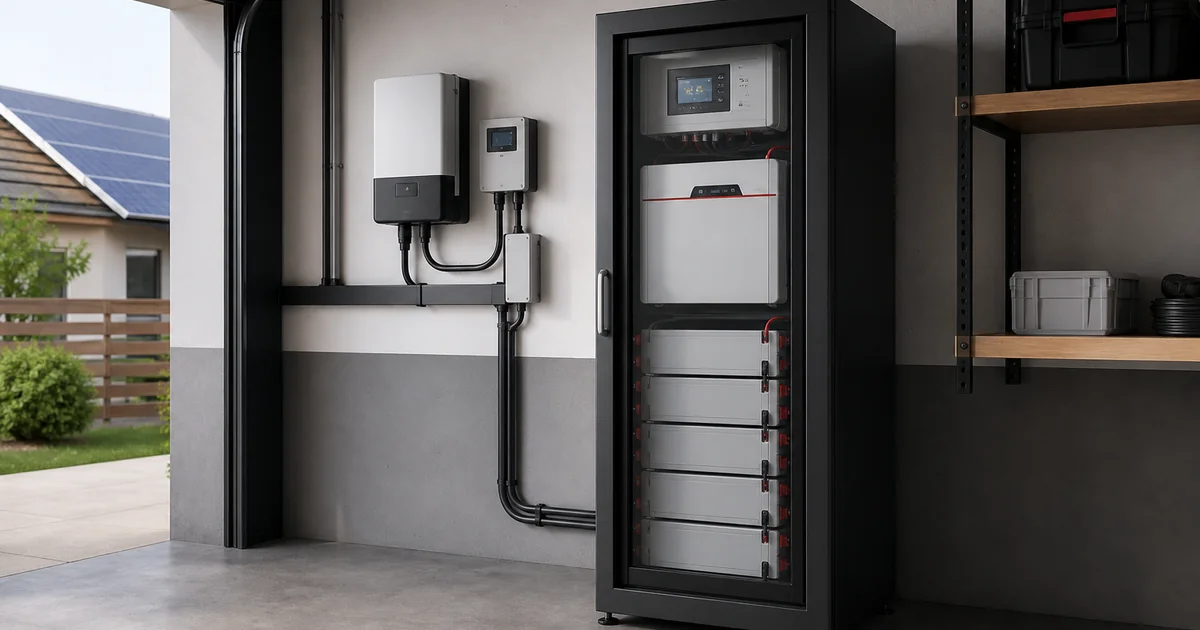
Sodium Ion All-in-One UPS: Working, Benefits and Applications
- Published 02 Aug, 2026
- 8 min read
A sodium-ion all-in-one UPS combines inverter, charger, battery management and sodium-ion storage in a coordinated enclosure. Load, runtime, surge demand and product certification still determine suitability.
What is a sodium ion all-in-one UPS?
An all-in-one UPS integrates power conversion, battery storage, protection and monitoring into a coordinated system. In a sodium-ion model, the battery cells store energy using sodium-based electrochemistry rather than lead-acid or lithium-ion chemistry. Integration can simplify installation because the inverter, charger and battery management are engineered together.
Products differ in power rating, usable energy, transfer behavior, output waveform, enclosure and certification. Buyers should evaluate the complete system rather than assuming that battery chemistry alone defines performance.
How sodium ion UPS works
During normal utility supply, the system powers or passes supply to the load according to its architecture while the charger maintains the battery within BMS limits. During an outage, the inverter converts stored DC energy to regulated AC for connected loads. The BMS monitors cell voltage, current and temperature and communicates limits to the power electronics.
Transfer time depends on whether the product is standby, line-interactive or online. Critical electronics may require zero-transfer online operation, while home loads may tolerate a brief transfer. Confirm the actual architecture rather than relying on the phrase all-in-one.
Benefits of sodium ion battery technology
Sodium is widely available, and sodium-ion technology is being developed for stationary storage where material diversity, safety characteristics and temperature performance may be valuable. Some products can offer good cycle life and integrated monitoring. Exact benefits depend on cell design and certified product data.
The technology is still less commercially mature than established lead-acid and LFP options in many markets. Buyers should verify warranty, service, replacement availability, tested cycle life and applicable safety certifications instead of relying on broad chemistry claims.
Sodium ion UPS vs conventional battery UPS
Lead-acid UPS systems are familiar and widely serviced but batteries can be heavy and require replacement based on temperature and cycling. LFP systems offer strong commercial maturity and energy density. Sodium-ion may provide an alternative balance of materials, temperature behavior and stationary-storage characteristics.
A chemistry cannot be swapped into an existing UPS without engineering review. Voltage window, charging profile, BMS communication, protection and thermal design must be compatible. An integrated system helps manage these interfaces.
Applications for homes and commercial spaces
Potential home loads include lighting, fans, communications, computers and selected appliances within the UPS surge and runtime limits. Commercial applications can include billing, networking, security, office electronics and essential control loads. High-power air conditioning, pumps or lifts need separate analysis.
An essential-load panel helps ensure that available energy supports priority circuits. Installation must provide suitable clearances, earthing, overcurrent protection and environmental conditions. Local electrical rules and manufacturer instructions apply.
How to choose the right UPS backup system
List load watts and starting surges, then decide the required runtime. Power rating determines what can operate at once, while usable battery energy determines duration. Include inverter and battery losses and avoid discharging beyond the permitted BMS limit.
Check output waveform, transfer time, recharge time, bypass, communication, warranty, certifications and service. Adroit can review residential or commercial loads and backup expectations before recommending a system.
Request both power and energy calculations: inverter kVA controls how much load runs at once, while usable battery kWh controls runtime. Include power factor, conversion loss, ageing allowance and surge from pumps or motors. Select genuinely critical circuits so unnecessary loads do not inflate capacity. The proposal should explain recharge time, repeated-outage behavior, monitoring, protection and installation scope. Verify operating temperature and service arrangements for the battery chemistry. These checks compare an integrated sodium-ion unit with conventional UPS options on actual duty rather than battery name alone. During handover, record the configured shutdown limits, alarm contacts and expected runtime at the commissioned load, then schedule periodic functional tests. Recheck runtime after meaningful load growth so backup expectations remain realistic. Keep firmware, settings and warranty documents available to authorized service personnel.
- Connected and surge load
- Required backup duration
- Usable battery energy
- Transfer requirement and waveform
- Recharge source and time
- Warranty, monitoring and service
FAQs
What is sodium ion UPS?
It is a UPS that stores backup energy in sodium-ion cells managed by a compatible charger, inverter and battery-management system.
Is sodium ion battery safe for UPS?
It can be safe when the complete product is correctly engineered, tested, protected and installed; verify certification and manufacturer documentation.
How is sodium ion UPS different from lithium UPS?
It uses different cell chemistry, voltage characteristics and material supply. Energy density, maturity, temperature behavior and cost vary by product.
Where can sodium ion all-in-one UPS be used?
It can support selected home, office, retail, communication and commercial essential loads within its power and runtime ratings.
Does sodium ion UPS need maintenance?
It needs inspection, firmware and alarm review, ventilation checks, electrical testing and periodic capacity assessment even if routine battery work is limited.
Related Products and Solutions
Related Articles
Need help choosing the right solution?
Contact Adroit Power Systems for stabilizers, UPS systems, power quality correction, solar UPS and industrial backup power guidance.